
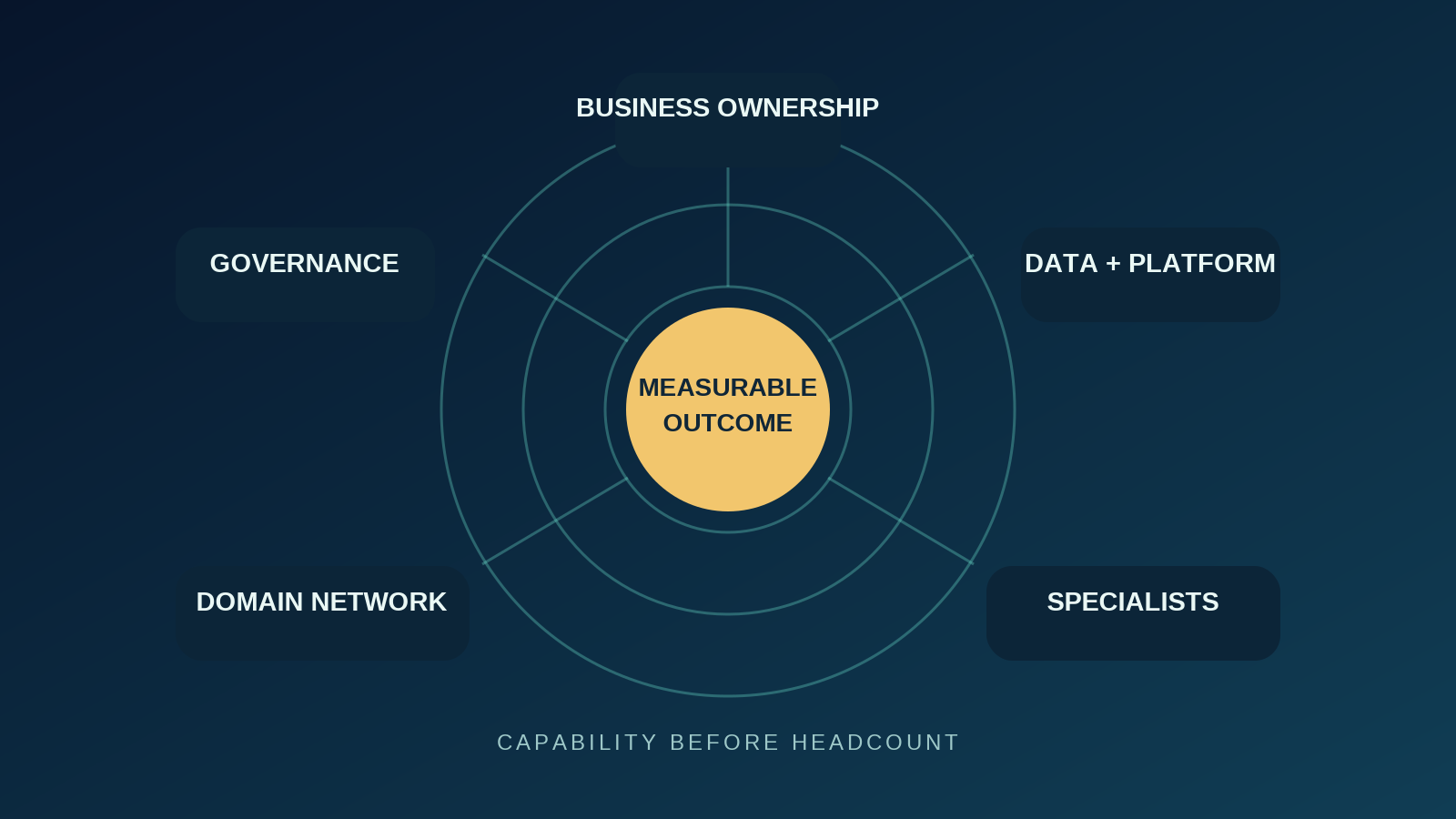
The most visible response to an AI talent shortage is to add headcount. It is also the easiest response to measure. But a larger AI team does not automatically create a stronger AI capability. My thesis is that Saudi and regional organizations should design the capability system first—decision rights, reusable platforms, domain ownership, learning loops and measurable business outcomes—then hire the few roles that close specific gaps.
The pressure is real. The IMF estimates that about 45% of jobs in Saudi Arabia are highly exposed to AI and that the share rises to roughly 80% among employed Saudis. It also identifies shortages in specialized AI research and engineering roles, global compensation competition, and mobility frictions as execution constraints. These are exposure estimates and institutional observations, not forecasts that the same share of jobs will disappear.[1]
Headcount is a lagging indicator of capability
A company can recruit data scientists and still fail to move a model into a governed workflow. It can train hundreds of employees and still leave them without approved data, a sandbox or an accountable business owner. It can buy an enterprise AI platform and still measure activity instead of economic value. The missing asset is usually not one more person; it is the operating system around the people.
| Layer | Executive question | Evidence before adding headcount |
|---|---|---|
| Business ownership | Which outcome and process will change? | Named owner, baseline, target and adoption path |
| Data and platform | Can teams build and reuse safely? | Approved data access, sandbox, evaluation and deployment path |
| Specialists | Which scarce judgment cannot be supplied internally? | Role scorecard tied to a delivery bottleneck |
| Domain network | Who knows the work well enough to redesign it? | Allocated subject-matter experts and workflow authority |
| Governance and learning | How will quality improve after launch? | Risk tier, review cadence, incidents, user feedback and measured value |
This distinction matters because AI work is broader than model building. GulfTalent’s analysis of 118,000 vacancies in Saudi Arabia, the UAE and Qatar found that AI-related duties, skills or tools appeared in 3.4% of professional vacancies in the first half of 2026, up from 1.2% in 2022. Among AI-connected vacancies, fewer than one in ten focused on building and training models; the rest emphasized using, implementing or selling AI. That is evidence that capability is spreading across products, operations and commercial roles—not that every organization needs a large research lab.[6]
Saudi Arabia has talent momentum—and a conversion challenge
Saudi Arabia is not starting from zero. A November 2026 SDAIA study, reported through the National Platform, states that more than 69,300 technical graduates entered the market from 2021 to 2025, domestic AI talent density grew at a 15% compound annual rate, and more than 1.2 million people participated in the first phase of the SAMAI initiative by July 2026. These are official reported figures. They show scale in awareness and pipeline; they do not by themselves prove deployment quality or commercial return.[2]
PwC’s Saudi AI maturity research sharpens the conversion question. Surveyed Saudi organizations reported strength in attracting technical AI specialists, but their largest gaps against the study’s AI leaders were role-based learning and employees’ willingness to trust and act on AI-generated insights. The practical implication is clear: specialist recruitment must be paired with learning designed for each role and with evidence that changes decisions in real workflows.[3]
Compensation remains part of the equation, but it should not become the strategy. Cooper Fitch’s 2027 KSA Salary Guide estimates an average salary increase of 3.1% and reports that AI, data and technology positions are among the harder categories to fill. Those figures are survey-based planning evidence, not a salary commitment for any particular company. Leaders should use them to test affordability and retention risk while keeping role design tied to an explicit bottleneck.[5]
GCC investment needs a joint human-and-agent plan
Across the GCC, the capital signal is stronger than the operating signal. PwC reports that 93% of surveyed technology leaders with budget visibility expect AI spending to increase, while only 21% say enterprise transformation is scaled or fully embedded. 46% identify skills and talent as a barrier to scaling AI agents, yet only 23% prioritize AI training. These findings support one planning discipline: model human capacity, agent capacity and workflow redesign together, against business outcomes and cost.[4]
That does not make GCC markets interchangeable. Saudi Arabia combines a large national transformation agenda, public-sector adoption and a growing domestic pipeline. The UAE has a different concentration of regional headquarters, international talent and private-sector platforms. Qatar, Bahrain, Oman and Kuwait each have distinct sector mixes, labor rules and institutional depth. A regional capability model can share standards and platforms, but ownership, data access, localization and hiring plans must be market-specific.
Wider MENA requires a different architecture
The IMF’s regional analysis places Saudi Arabia and the UAE among the most prepared and highly exposed economies in the Middle East and Central Asia, while noting that many economies outside the GCC face tighter access to capital, infrastructure and advanced AI components. It also warns that younger workers can be concentrated in entry-level roles with lower complementarity potential. The responsible regional answer is not to copy a capital-heavy Gulf model. It is to build portable learning, shared evaluation tools, local language assets and partner networks that let smaller organizations participate without owning every layer.[8]
The counterargument: hire scarce people before competitors do
There is a serious counterargument. Scarce senior researchers, platform engineers, product leaders and AI risk specialists can shape the entire system; delaying recruitment may leave an organization dependent on vendors or unable to absorb new technology. I agree that some hires should happen early. The discipline is to distinguish a foundational role from a prestige role. A foundational hire arrives with a mandate, access, budget, decision rights and a ninety-day delivery test. A prestige hire arrives with a title and a vague expectation to ‘lead AI.’
The global labor market will keep shifting. The World Economic Forum expects AI, big data and cybersecurity skills to grow quickly while analytical thinking, resilience, leadership and collaboration remain essential. It also reports that 77% of surveyed employers plan to upskill workers in response to AI. The durable team is therefore not technical versus human; it combines technical depth with domain judgment, change leadership and continuous learning.[7]
Six decisions for the next ninety days
First, select three workflows where AI could change revenue, cost, risk or service quality and record the current baseline. Second, assign a business owner with authority to redesign each workflow. Third, map the reusable platform, data and governance services needed across all three. Fourth, identify the exact specialist bottlenecks and decide whether to hire, contract, partner or train. Fifth, create role-based learning for the people who must use and supervise the system. Sixth, review adoption, quality, cost and business value every month; do not substitute model accuracy or course completion for operating evidence.
For founders, this approach protects runway. For established companies, it reduces the chance that AI hiring becomes an isolated center of excellence. For governments and ecosystem builders, it turns national training scale into institutional capability. The winning metric is not the size of the AI team. It is the number of important decisions and workflows that improve—safely, repeatedly and with evidence.
Key takeaways
- Design the business, platform, domain and governance layers before treating headcount as the solution.
- Use Saudi talent-growth and salary evidence as planning inputs, not proof of delivery or a compensation commitment.
- Plan human capacity, agent capacity and workflow redesign together; GCC markets still require local ownership and controls.
- Authorize each scarce hire against a named bottleneck, ninety-day delivery test and measurable business outcome.