
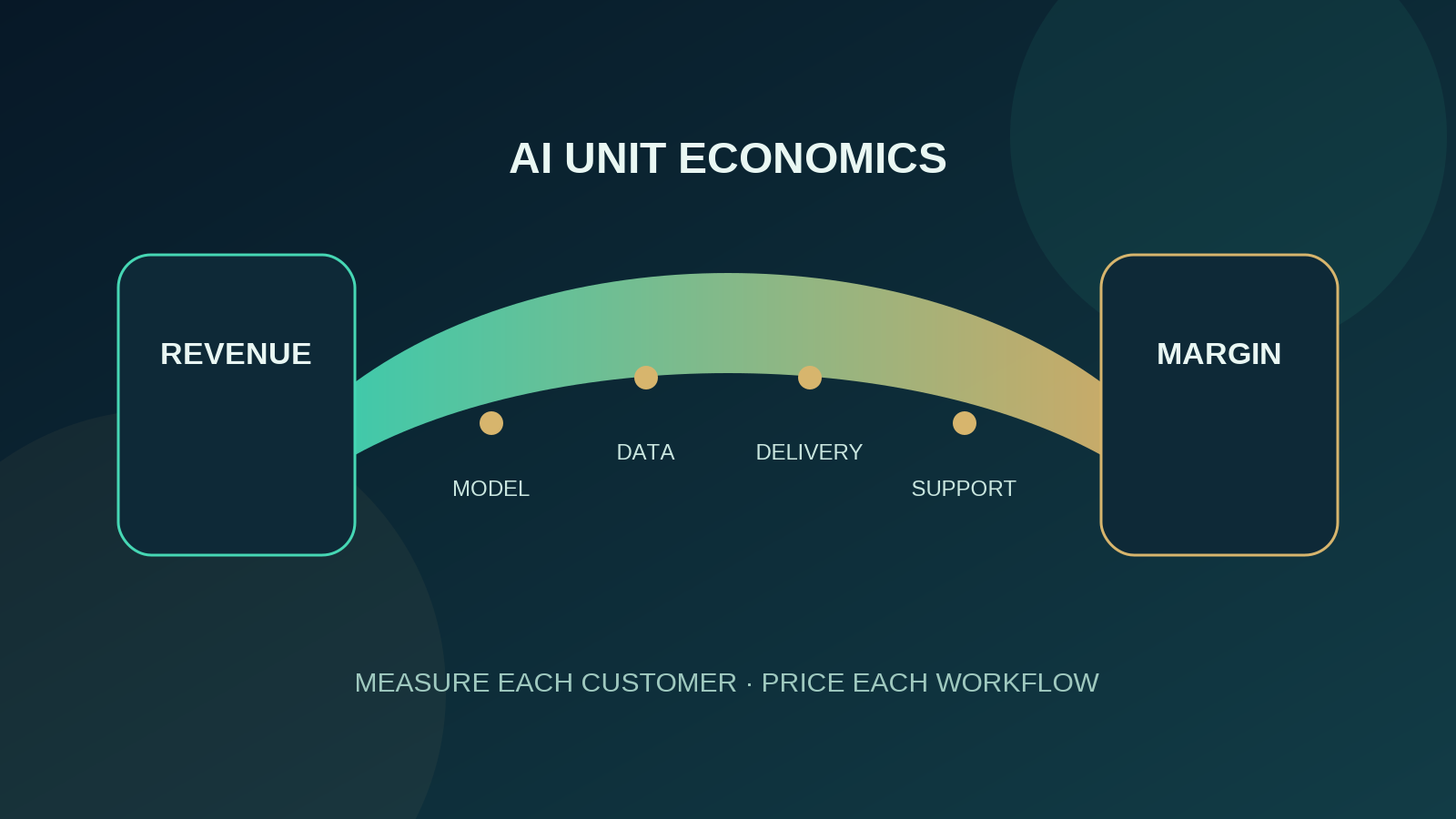
AI has changed the cost structure of software. A conventional product can often serve another user at a small incremental cost. An AI product may incur model, retrieval, tool, data and review costs every time a workflow runs. That does not make AI ventures unattractive. It makes contribution-margin discipline a product requirement, not a finance exercise postponed until fundraising.
My thesis is straightforward: founders should know the contribution margin of each material customer workflow before they scale it. Adoption, annual recurring revenue and impressive demonstrations are useful signals, but none proves that the product becomes more valuable faster than its cost to serve.
Unit economics must come before the valuation story
A recent Federal Reserve staff paper describes significant AI-lab revenue alongside continuing profitability pressure. It separates inference, current-model research, next-generation research and overhead, and notes publicly stated inference gross margins of roughly 30 to 40 percent for leading labs. Those estimates describe model providers, not every application company, but they underline a basic point: intelligence has a measurable variable cost and scale does not automatically erase it.[1]
Provider price tables reinforce the operating choice founders face. OpenAI's current API page lists materially different prices by model, speed, context and caching treatment, and applies an uplift to qualifying regional-processing endpoints. The practical lesson is not to select the cheapest model in isolation. It is to route each task to the lowest-cost configuration that still meets quality, latency, security and data-residency requirements, then reconcile actual usage to the invoice.[2]
Enterprise adoption is rising faster than verified financial impact
McKinsey's 2026 global survey reports that nearly nine in ten respondents use AI regularly in at least one business function and 44 percent say it is scaling across the enterprise. Yet only 37 percent attribute at least some EBIT impact to AI, essentially unchanged from the prior year, while operating costs constrain use for about one in five organizations. The gap between use and enterprise value is the market signal founders should study.[3]
Deloitte's 2026 survey of 3,500 business and technology leaders finds that 71 percent track total inference and API spend, but only 51 percent track token volume and 44 percent track per-unit inference cost. It also reports revenue gains from AI at 28 percent of respondents. These are survey findings, not audited returns, but together they show why a vendor must sell measurable workflow outcomes while exposing the cost drivers underneath them.[4]
Saudi capital is becoming more selective
MAGNiTT's H1 2026 Saudi Arabia report, produced with Saudi Venture Capital, says funding fell 74 percent year on year while deal count fell 41 percent. Saudi Arabia still ranked second in the region by funding and deal count, but international participation concentrated more heavily at pre-seed and seed stages. A correction after a record year does not mean capital disappeared; it means operating evidence matters more.[5]
SVC's current reports library documents the institutional depth behind the ecosystem, including its January 2026 impact report and the FY2025 Saudi venture-capital report. The opportunity is therefore not a choice between ambition and discipline. Saudi founders can build for a well-supported market while treating customer-level economics, collections and retention as evidence for the next tranche of capital.[6]
The contribution-margin bridge an AI founder needs
| Line | Include | Decision |
|---|---|---|
| Recognized revenue | Subscription, usage, implementation and support revenue | What was earned in the same period? |
| Model and compute | Inference, embeddings, vector search, hosting and orchestration | Which tasks and customers create the cost? |
| Data and tools | Licensed data, search, maps, communications and third-party actions | Which costs rise with usage or compliance? |
| Delivery and review | Onboarding, human review, exception handling and customer success | Is service work being mistaken for software margin? |
| Contribution margin | Revenue minus all directly attributable costs | Should the workflow be repriced, redesigned, bounded or stopped? |
The calculation should be performed by customer and by workflow, not only as a blended company average. A profitable document-classification flow can hide an unprofitable agent that repeatedly calls premium models, searches external systems and escalates to human reviewers. Aggregate margin makes both look acceptable until the expensive workflow becomes the fastest-growing one.
For each workflow, I would also track gross retention, successful-task rate, human-intervention rate, latency, failed-call cost, credits and refunds, collection days and the effect of data-residency or regulated-processing choices. These metrics connect product quality, cash conversion and trust instead of treating finance as a separate dashboard.
The counterargument: model costs will keep falling
They may. Caching, smaller models, improved hardware, open weights and competition can reduce the cost of a task. But a lower unit price does not guarantee a stronger business. Customers may demand lower prices, competitors may pass savings through, context windows and agent steps may expand, and regulation may require more expensive controls. Cost decline is an opportunity to redesign the workflow; it is not permission to ignore its economics.
Saudi, GCC and MENA decisions are related—not identical
In Saudi Arabia, enterprise procurement, Arabic quality, local hosting choices, integration effort and collection cycles can be decisive. Across the GCC, data rules, buyer structures and public-sector pathways differ by jurisdiction. In broader MENA markets, price sensitivity, cloud availability and payment risk may change the viable package. A single regional price and delivery model can therefore conceal several different businesses.
The entrepreneurial mechanism is clear: AI converts a manual or fragmented workflow into a repeatable product, but the venture becomes defensible only when it owns the workflow design, evidence, customer integration and learning loop—not merely access to a model API. The AI role is direct in execution; the entrepreneurial value comes from bounding the problem and pricing the outcome.
What founders and investors should decide now
Before the next growth push, select the three highest-volume workflows and rebuild their economics from invoices, usage logs, delivery time and recognized revenue. Set a target contribution margin and a maximum cost per successful outcome. Then decide which tasks need a premium model, which can use a smaller model, which should be cached or batched, and which should require a human checkpoint.
The decision rule is simple: scale evidence, not activity. If a workflow creates measurable customer value and retains a healthy margin after its real delivery cost, accelerate it. If the margin depends on temporary credits, unpriced implementation work or optimistic usage assumptions, redesign the contract before growth makes the correction more expensive.
Key takeaways
- Measure contribution margin by customer and workflow, not only at company level.
- Reconcile model usage, third-party tools, delivery and human review to recognized revenue.
- Treat falling model prices as a redesign opportunity, not as guaranteed future margin.
- Adapt pricing and delivery separately for Saudi, GCC and wider MENA operating realities.