
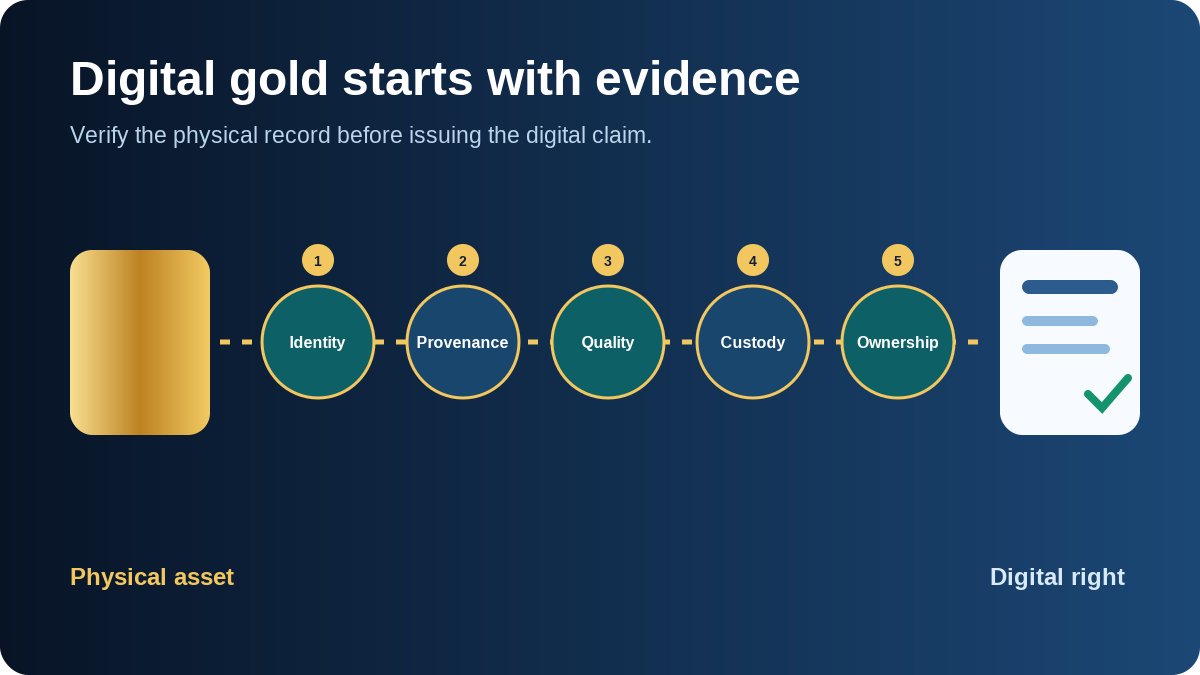
The most important design decision in digital gold is not the token standard. It is the evidence model beneath it. A digital unit can move instantly, while the physical metal, its assay, custody status and legal ownership move through slower institutional processes. If those worlds are not continuously reconciled, speed only distributes uncertainty faster.
My thesis is simple: the durable product is a trust layer that makes every important handoff verifiable. Tokenization may become one interface to that layer, but it cannot substitute for provenance, inspection, custody controls, customer due diligence or redemption discipline.
Saudi rules already point toward structured evidence
Saudi amendments effective from 11 October 2025 divided manufacturing and retail oversight between the Ministry of Industry and Mineral Resources and the Ministry of Commerce. Published requirements include industrial licensing for manufacturing, identification tags for jewellery set with gemstones, disclosure of type, weight, fineness and price in advertising, and special invoice information when establishments buy items from individuals. These are legal and commercial records, not blockchain requirements. They nevertheless show why a digital platform must preserve product identity and transaction evidence before beginning with a financial-asset layer.[1]
For a Saudi manufacturer or retailer, the first useful digital object may be a controlled item record: mould and batch, unique item number, production date, weight, fineness, assay result, gemstone disclosure, current location, responsible party and linked invoices. Some fields are regulatory; others are proposed operational controls. The system must distinguish them.
Global standards raise the evidence bar
LBMA's current Responsible Gold Guidance describes traceability from origin and upstream partners through each lot refined and the first destination of each shipment. It lists evidence such as origin documentation, unique input and output references, weight and assay, transport documents and processing dates. It also says blockchain, machine learning or AI may enhance transparency where feasible. The word 'enhance' matters: technology supports controls; it does not erase the need for them.[2]
The direction is becoming more demanding. LBMA's proposed Responsible Gold Guidance Version 10 adds minimum provenance points, stronger treatment of secondary gold and expanded audit expectations for higher-risk streams. As of 26 November 2026, the final version was scheduled for December 2026, so these provisions remain proposals rather than final obligations.[3]
The OECD places responsibility for minerals due diligence on companies across the supply chain. Its 2026 work also explains why precious metals are exposed to money-laundering risk: high value, durability, mobility and the possibility of mixing legal and illegal sources. This is not an argument against digital gold. It is an argument for risk-based onboarding, supplier evidence, exception handling and auditable escalation.[4]
Digital ownership is moving from concept to infrastructure
On 24 November 2026, the World Gold Council announced first live pilot transactions using Pooled Gold Interests with major financial institutions. The announcement describes a wholesale model intended to let institutions own, transfer and use gold through digital infrastructure. A pilot is not proof that every market design is ready, but it shows credible work concentrating on shared infrastructure, custody coordination and institutional rules—not token issuance alone.[5]
Earlier in 2026, Reuters reported that rising tokenized-gold demand came with custody and regulatory risks that were not always obvious to investors. A digital certificate can look simple while hiding questions about allocated versus pooled metal, bankruptcy remoteness, inspection rights, fees, liquidity and redemption.[6]
Five gates before a gold record becomes investable
| Gate | Evidence | Decision |
|---|---|---|
| Identity | Item, batch, supplier and responsible party | Is the record uniquely attributable? |
| Provenance | Origin, invoices, logistics and prior custody | Can the chain be reconstructed? |
| Quality | Weight, fineness, assay and disclosures | Does the item match its description? |
| Custody | Location, custodian, inspection and reconciliation | Is the metal present and controlled? |
| Ownership and redemption | Legal owner, constraints, transfer and delivery terms | Can rights be enforced and redeemed? |
Only after identity, provenance, quality, custody, ownership and redemption rules are defined should a company decide whether a token adds value. For a factory, the first return may come from production control and inventory accuracy. For a retailer, it may be compliant product information and resale history. For a financial product, custody segregation, legal rights, investor eligibility, disclosure, transfer restrictions, settlement and redemption all need explicit owners.
The counterargument: an ERP and a label may be enough
That objection is often correct. If one organization controls the workflow and counterparties already trust its database, a conventional ERP, signed audit log and tamper-evident label may solve the problem more cheaply. A distributed ledger becomes useful only when multiple parties need a shared state, no single database is accepted as authoritative, and governance exists for corrections and disputes. Otherwise, blockchain creates another database to reconcile.
The same discipline applies to AI. Machine learning may help detect anomalous weights, repeated identifiers, unusual supplier patterns or inconsistent images. It should produce reviewable signals, not autonomous declarations of authenticity. False confidence is especially costly when the asset is portable, valuable and easy to remelt.
What founders and institutions should decide now
For Saudi founders, the opportunity is a bilingual evidence and workflow layer that connects manufacturing, retail, invoicing, custody and regulated-finance systems. For GCC operators, cross-border interoperability matters, but legal roles and disclosure rules cannot be assumed identical. Across broader MENA markets, the system may need to accommodate fragmented upstream data and gradual supplier onboarding without presenting missing evidence as verified provenance.
I would start with one bounded pilot: select a product category, define evidence at each handoff, assign accountable owners, connect the physical identifier to the digital record, and test reconciliation plus redemption or resale. Measure exception-resolution time, inventory variance, evidence completeness and disputed transfers. Token issuance should be a later decision gate, not the opening milestone.
Digital gold will not earn trust because it is digital. It will earn trust when a buyer, auditor, regulator and custodian can examine the same chain of evidence, understand its limits and resolve exceptions without breaking the link between the physical asset and the recorded right.
Key takeaways
- Begin with verified physical and legal records; token issuance is not proof of provenance.
- Separate regulatory requirements, industry guidance and proposed platform features.
- Use blockchain or AI only where they improve multi-party verification or reviewable risk detection.
- Pilot one product flow and measure reconciliation, evidence completeness and exception resolution before financialization.