
If your team woke up tomorrow with a hundred times its current computing power, what experiment would it run? If the answer is to train a larger model, my next question is what you expect it to learn and how you will know it has learned it.
That question stayed with me after reading Ilya Sutskever’s November 2025 interview with Dwarkesh Patel. The OpenAI co-founder and former chief scientist considered what scaling could achieve now that models are already so large. He expected a hundredfold increase in scale to make a difference. He questioned the assumption that it would transform everything. It is a striking observation from a researcher who helped demonstrate the value of scale.[1][2]
Why did companies embrace scaling?
Sutskever roughly divides recent AI history into two eras. Between 2012 and 2020, labs tried different ideas to discover which ones worked. Between 2020 and 2025, the industry had a clearer path. When researchers increased model size, training data and compute together, they could anticipate performance gains with enough confidence to justify the next investment.[1]
The appeal is easy to see from the investment side of the table. Management can explain what the extra budget will buy, how long training will take and which metric should improve. A researcher with a different way to teach a model has to ask for funding before knowing whether the idea will work. Repeat that choice across dozens of firms and Sutskever’s observation makes sense. In his view, there are now far more companies than distinct ideas being tested.[1]
Global investment in data centres across all uses reached about $500 billion in 2024, nearly double its level in 2022, according to the International Energy Agency. Researchers at Epoch AI estimated that between 2026 and 2032 training datasets could use the effective stock of publicly available human-written text if the scaling trends they studied continued. The first figure measures actual investment. The second is a conditional forecast. Together they raise an economic question for any lab that finds it easier to buy more compute than to find fresh material its models can learn from.[3][4]
What did eight GPUs accomplish?
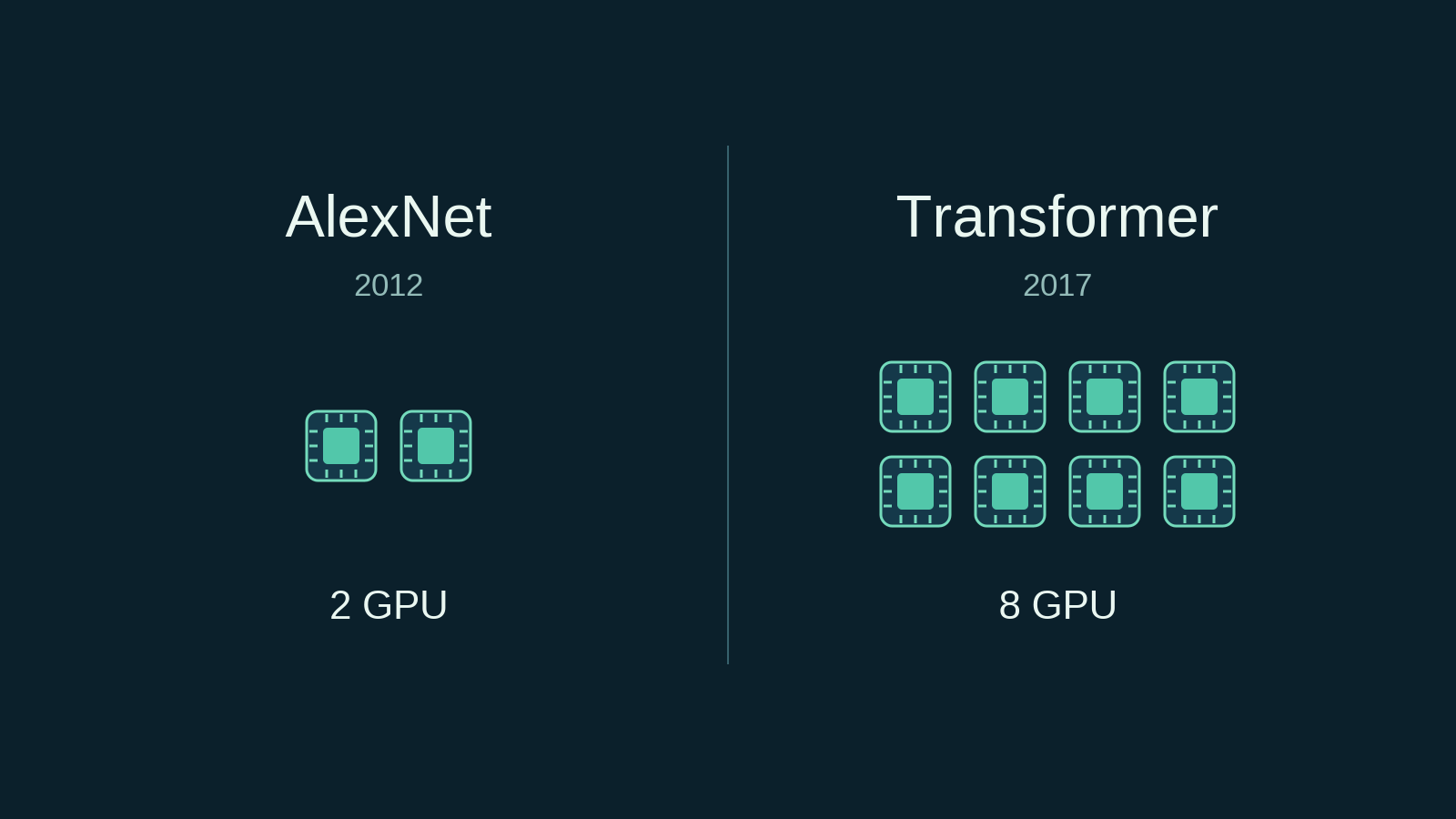
In 2012, Sutskever and two colleagues used two graphics processing units to train AlexNet to classify images. Five years later, another team tested a different idea in machine translation. Its Transformer architecture allowed a model to weigh which words in a sentence mattered most for interpreting a particular word. On an English-to-French translation benchmark, the model achieved the best published result for a single model at the time after three and a half days of training on eight GPUs.[2][5][1]
What matters to me is the order of events. The team changed how a model processed language, chose a task with a measurable outcome and produced evidence worth testing at greater scale. Compute was valuable because the researchers had a specific question they knew how to use it to answer.
Where is the Saudi opportunity?
Saudi Arabia spent SAR 29.48 billion on research and development in 2024, up 30.4% from the previous year. Businesses accounted for 40.3% of total expenditure. That share matters to me because a company facing an operational problem every day knows something a lab may struggle to discover on its own. It knows where the error occurs, who bears its cost and how much improvement would justify changing the way people work.[6]
Consider a hypothetical geospatial application. A municipality wants to track urban expansion from satellite imagery, but the system sometimes sends inspectors to investigate a change caused by the camera angle. I would fund an experiment comparing a larger model with one trained on local examples reviewed by specialists. Test both approaches on neighbourhoods held out of training, then ask two questions that matter to the researcher and the operations manager alike. How many site visits did we save? How many real changes did we miss? The decision to expand now rests on costs and outcomes we can verify.
This is why my next bet in AI is on research and development. As someone who builds and invests in companies, I want a founder to tell me about one mistake their model made before telling me how many processors they need. How did they find it? What did they learn? What is the smallest experiment that can tell them whether they are heading in the right direction? Their answers will tell me where the next riyal belongs.
Key takeaways
- Specify what the model should learn and how you will test it.
- Compare additional compute with better local training examples.
- Measure the effect on a real operational decision.